Apollo 11 Sim
Repo: github.com/Mastaba/apollo11-sim
This one’s been a long time coming. Years ago I picked up a water-stained NASA technical manual at a Goodwill in Michigan’s Upper Peninsula, mostly because the appendix was pages of card-deck FORTRAN and that felt like finding a fossil. I didn’t do anything with it at the time — it just left me with a soft spot for old NASA software that never really went away.
Fast forward to this year, when I went down a Wikipedia rabbit hole on the Apollo 11 missing tapes — the original high-quality telemetry recording of the first moonwalk, erased and reused by NASA in the early ’80s during a tape shortage, so all that survives is the degraded broadcast version shot off a monitor. Reading about it, I realized I didn’t actually know what happened on July 20–21, 1969, step by step. I knew the highlight reel — the landing, “one small step,” the flag — not what Columbia and Eagle were actually doing minute to minute for the full eight days.
So I went looking for the next best thing to the missing tapes: the flight computer’s own memory. Turns out the Virtual AGC project has spent years preserving the actual Apollo Guidance Computer software, free, on GitHub — not a recreation, but Comanche 055 (Columbia) and Luminary 099 (Eagle), byte-identical to what flew, runnable on yaAGC, an open-source emulator of the real AGC hardware.
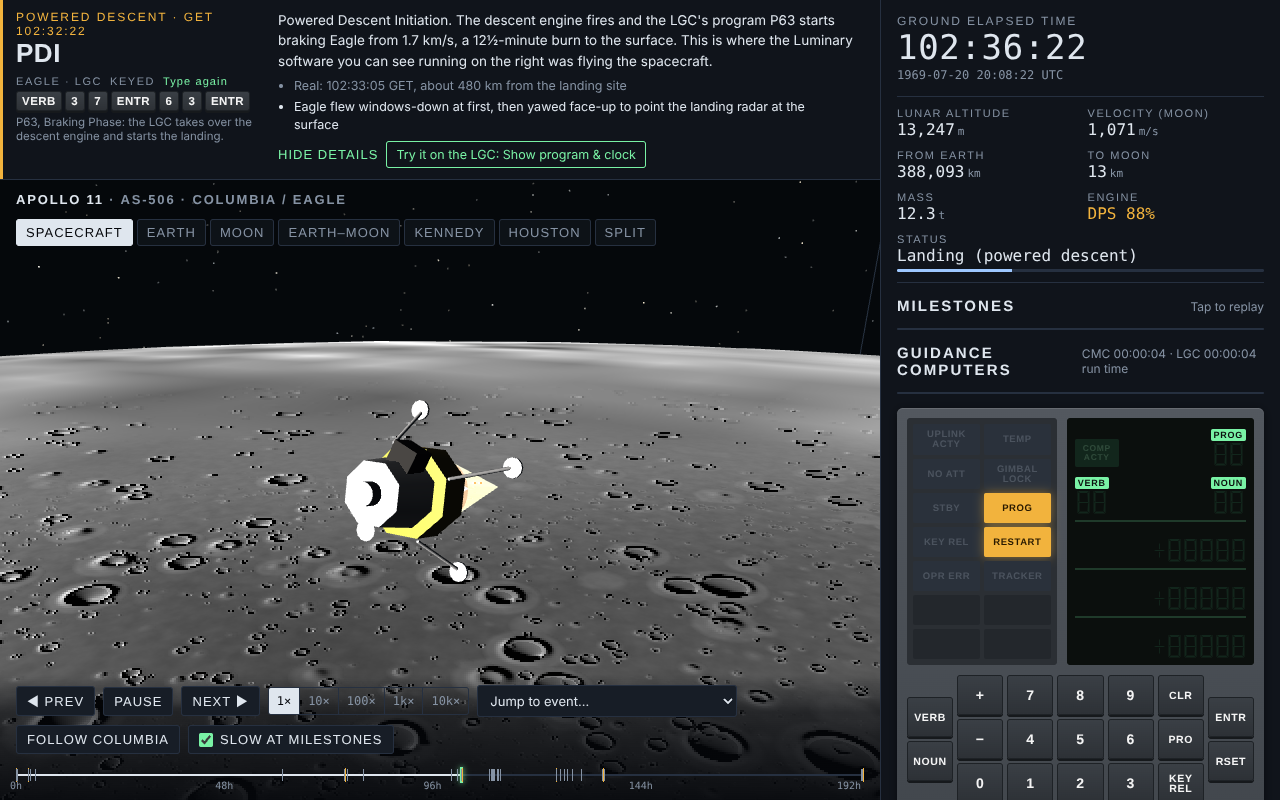
With that in hand, I worked with Claude to build apollo11-sim: a browser simulation of the entire mission, told from the ship’s side rather than a narrator’s. It launches at the actual moment — Pad 39A, July 16 1969, 13:32 UTC — and flies the real trajectory in full 3D, with proper lunar/solar positions, Earth’s rotation and oblateness, and correct lunar orientation. Underneath, yaAGC is compiled to WebAssembly and runs the real rope images in the browser, driving a functional DSKY you can type actual mission keystrokes into and get the period-correct response from. Three.js handles the rendering, with modeled ground views of 1969 Kennedy Space Center and Mission Control, and about fifty documented milestones with plain-English explanations covering docking, undocking, powered descent, the landing, the moonwalk, and re-entry.
The two models floating alongside this post aren’t renders or photos — that’s the actual simulator source, pulled out and running right here on the page. Nothing in apollo11-sim is an imported 3D model file; Columbia, Eagle, and the Saturn V stack are all just cones and cylinders assembled by code, the same code that flies them in the real sim.
None of the history is new — it’s all public record. What was missing, for me, was ever seeing it assembled end to end and driven by the actual code the ship was running, instead of a documentary’s summary of it. The tapes of the first moonwalk are gone for good, but it turns out the instructions the ship itself was following the whole time were never lost — they were just sitting in a repository, waiting for someone to ask them to run again.